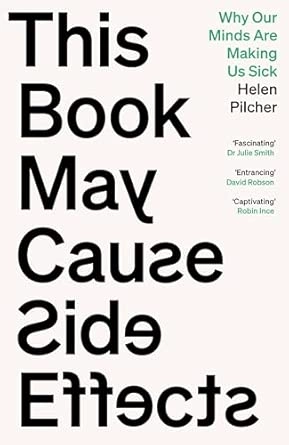
This Book May Cause Side Effects
by Helen Pilcher
Interesting read about the nocebo effect, essentially the evil twin of the placebo effect. The nocebo effect is the effect whereby if you tell people the side effects of medicines, they are more likely to get them. Or people who think they will age less well, get more ill in old age than those who don't think this. You can make people really physically ill by implanting thoughts in their head that they have a cancer or some other disease. You can even condition them, like a dog and the Pavlov effect, so that they become ill just by smelling lavender for example.
The book shows how the internet has made these things worse. How the "mirror gene", which copies other people's expression in order to show empathy, used to have limited scope since you had to see people in person. With the internet this is no longer needed - the effect works at a distance through the screen. This has led to the term, Mass Psychogenic Illness or MPI. It was especially strong during Covid with people locked inside on their screens.
Nocebo can even have an effect on cancer, although the effect is currently proven more along the lines of causation indirectly. Nevertheless in mice a study has shown how stimulating certain parts of the brain can make cancer grow or recede. The implication being that bad thoughts could cause cancer.
The book describes how in recent years, things which were previously just accepted as a part of life, are now given a medical label and then treated by big pharma with medicines, especially in the area of mental health. The Diagnostic ans Statistics Manual for Mentla Disorders, DSM, has mental illnesses such as caffeine withdrawal, prolonged grief disorder and internet gaming disorder.
And now in the era of Google and TikTok, people are self diagnosing, often basing their diagnosis on influencers with questionable knowledge on the topics they write about. This has led to the term cyberchondriac. Studies have shown how 94% of videos about nutrition contain misleading or factually incorrect information. The rate is 84% for mental health and 44% for medical problems. Only 9% of such influencers sharing information about mental health are qualified mental health professionals.
The book closes with a call to action to raise awareness of the nocebo effect amongst the medical profession as well as the general population.
Overall the book is an interesting read, but it did not need 380 pages to make its a point. Probably could be done in a longer Sunday feature in a newspaper.
From 17.05.2026 to 22.06.2026